
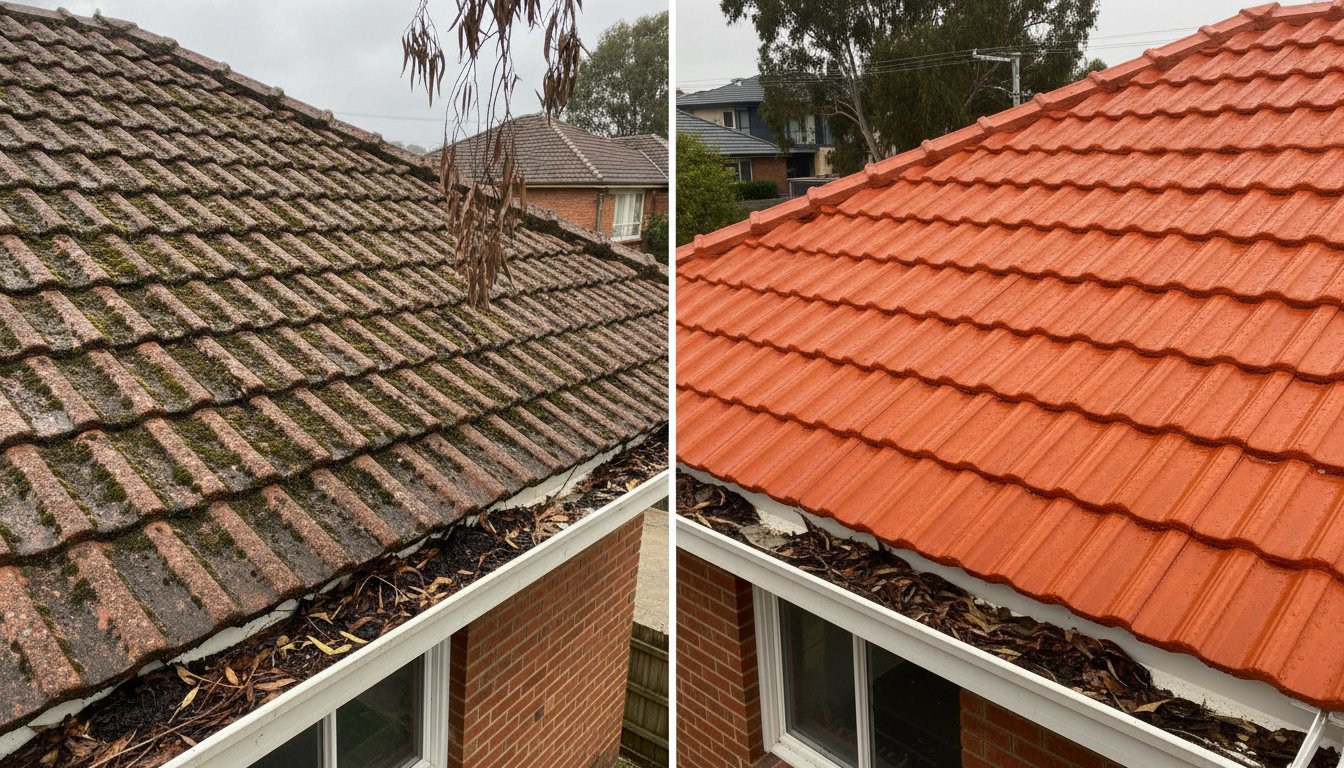
Did you know that the moss on your roof can retain up to 2.5 litres of water per square metre, adding an extra 25kg of weight to your structure? For many in Victoria, this green growth is often dismissed as a minor eyesore, but it’s actually the primary cause of recurring drainage failures. When heavy rain hits, these water-logged clumps break loose and slide into your channels. This makes professional roof cleaning to prevent gutter damage Melbourne a vital part of home maintenance rather than just a cosmetic choice.
We understand the frustration of clearing your gutters only to find them overflowing again after the next storm. It’s also natural to worry that aggressive cleaning methods might crack your tiles or cause internal leaks. This guide explains exactly why our local climate acts as a greenhouse for moss and lichen. You will learn how to identify early warning signs of drainage stress and discover the safest ways to protect your home. We will also explore how modern, low-impact treatments like BioShield provide a long-term alternative to frequent pressure washing, keeping your roof pristine and your gutters functional for years.
Key Takeaways
- Understand why Melbourne’s high humidity and temperate winters create the ideal breeding ground for moss and lichen on your roof tiles.
- Discover why roof cleaning to prevent gutter damage Melbourne is essential for stopping water-heavy moss clumps from sliding into and blocking your drainage system.
- Compare the differences between mechanical pressure cleaning and chemical soft washing to determine the safest method for your specific roofing material.
- Learn how to perform a safe ground-level visual inspection using our 5-step checklist to spot early warning signs of biological growth.
- Explore the benefits of a holistic maintenance approach that combines roof treatment with industrial-grade vacuuming for a complete, mess-free result.
Why Melbourne Roofs are a Magnet for Moss and Lichen
Roof moss isn’t just a garden plant that took a wrong turn. It’s a non-vascular organism that thrives in damp, shaded environments where sunlight rarely reaches. For Melbourne homeowners, this growth is a constant battle. Our city’s unique weather patterns and lush greenery make our roofs an ideal habitat for biological colonization. Understanding why this happens is the first step in choosing the right roof cleaning to prevent gutter damage Melbourne residents often face.
We frequently observe what we call “Southern Side Syndrome” during our property assessments. Because the southern aspect of a Victorian home receives the least direct sunlight, it remains damp for much longer after a rain event. This lack of UV exposure allows moss to establish a foothold without the risk of drying out. In leafy suburbs like Camberwell or Frankston, the problem is intensified by the surrounding canopy. Native eucalyptus and large deciduous trees drop organic debris that settles in the tile laps. This debris traps moisture and provides a nutrient-rich base for moss and lichen to flourish.
The Role of Melbourne’s “Four Seasons in One Day”
The rapid weather shifts in Victoria are a primary driver of roof degradation. Damp, misty mornings followed by humid, sunny afternoons create a literal greenhouse effect on your roof surface. This cycle is perfect for airborne spores that travel from nearby parklands and gardens. Once these spores settle, the moss uses tiny hair-like structures called rhizoids to anchor itself deep into the porous surfaces of terracotta and concrete tiles. Unlike plants with roots, these rhizoids can grip onto the smallest imperfections in the tile, making them difficult to dislodge through simple rinsing alone.
Moss vs. Lichen: Identifying the Growth
It’s helpful to distinguish between the two main types of growth we encounter. Moss is typically thick, green, and “fluffy” in appearance. It acts as a heavy sponge, holding significant amounts of water against your roof. Lichen is a different beast altogether. It’s a symbiotic relationship between algae and fungi, appearing as “crusty” or “leafy” patches of yellow, grey, or orange.
Lichen is notoriously difficult to remove because it chemically bonds to the tile surface. On the Mornington Peninsula, the presence of coastal salt air can actually accelerate the hardening of these lichen patches, making them feel like they are part of the tile itself. Different Roof cleaning methods are required to treat these growths effectively without causing structural harm. While moss is the main culprit for immediate blockages, lichen slowly degrades the tile’s protective coating. If you are dealing with stubborn yellow or grey spots, our dedicated guide on lichen removal from roof tiles Melbourne explains why a professional chemical solution delivers far superior long-term results compared to mechanical force. Both issues demonstrate why professional roof cleaning to prevent gutter damage Melbourne is a practical necessity for long-term home maintenance.
The Real Link Between Roof Moss and Gutter Damage
While moss on your tiles might look like a harmless bit of greenery, it functions as a heavy, water-logged sponge. Moss can retain up to 2.5 litres of water per square metre, which significantly increases the load on your roof structure. This constant moisture isn’t just a weight issue. It’s the starting point for a chain reaction that compromises your entire drainage system. Investing in professional roof cleaning to prevent gutter damage Melbourne is a proactive way to stop this cycle before it starts.
During heavy Melbourne rain, the force of water flowing down the pitch dislodges these moss clumps. They migrate directly into your gutter channels. Unlike dry leaves, which might blow away, wet moss is heavy and sticky. It settles at the bottom of the gutter, trapping fine sediment to create a thick organic sludge. This “silt effect” provides a perfect nutrient-rich bed for weeds to take root right in your gutters. Over time, this sludge hardens, making it nearly impossible for water to reach the downpipes.
How Moss Blocks Your Drainage System
These large clumps often act as “plugs” in the narrow bends of your downpipe system. Once a downpipe is restricted, water backs up quickly during storms, leading to overflows that can saturate the ground near your home. This is a serious concern because blocked gutters can lead to costly foundation damage over time. Properties with significant growth typically require gutter cleaning twice as often as those with clean roofs. If you’re tired of constant maintenance, removing the source of the debris is the most logical next step.
Structural Risks to Tiles and Cladding
Beyond the gutters, moss causes direct structural harm to your roofing material. Its rhizoids, or tiny anchors, can slowly lift the edges of tiles. This creates gaps where wind-driven rain can enter your roof cavity. In the Asphalt Roofing Manufacturers Association guide, experts note how organic growth can cause materials to curl or degrade prematurely. Melbourne’s winter freeze-thaw cycle exacerbates this. Water trapped by the moss expands as it freezes, which can widen existing cracks in terracotta or concrete.
Even Colorbond roofs aren’t immune to these biological threats. Damp moss sitting against the edges of metal sheets for months can lead to edge rust and corrosion. If you’ve noticed green clumps in your downpipes or dark streaks on your tiles, it might be time to organise a professional assessment to protect your home’s long-term health. Using specialized roof cleaning to prevent gutter damage Melbourne ensures that your drainage system remains clear and your tiles stay intact through every season.
Soft Washing vs. Pressure Cleaning: Which is Better for Melbourne Homes?
Choosing the right method to clear your roof is a decision that impacts the longevity of your tiles and the health of your drainage system. While high-pressure cleaning is a common sight, it often focuses on immediate visual results rather than long-term biological eradication. For sustainable roof cleaning to prevent gutter damage Melbourne residents need a solution that addresses the root cause of the growth. Mechanical force alone often fails to kill the microscopic spores hidden in the pores of the tile, leading to rapid regrowth within months.
High-pressure water can also present significant safety risks if not managed by a specialist. The sheer force can easily drive water under tile laps or through small cracks, potentially flooding ceiling cavities and damaging insulation. Professionals recognize the dangers of roof moss and the risks associated with power washing, which is why the industry is shifting toward more sophisticated, low-pressure alternatives. The same principle applies when considering professional driveway cleaning Melbourne services, where using the correct pressure and technique is equally critical to avoid damaging concrete or pavers.
The Danger of High-Pressure Water on Older Tiles
Many Melbourne homes feature classic terracotta or concrete tiles that have weathered decades of sun and rain. These materials become more brittle with age. High-pressure cleaning can strip the protective glaze from terracotta, leaving the surface porous and even more susceptible to future moss colonization. Beyond the tiles themselves, the force can dislodge mortar pointing and bedding on ridge tiles, leading to structural instability. This is why many manufacturers advise against high-pressure methods, as improper cleaning can sometimes void your product warranty.
The BioShield Advantage: Long-Term Prevention
We prefer a methodical “soft wash” approach using BioShield roof treatment. Unlike a one-off blast of water, this specialized treatment works over 6 to 12 months to gently break down organic growth. It utilizes the natural cycle of wind and rain to self-clean the roof surface without the need for aggressive scrubbing. This method offers several key benefits:
- Water Conservation: It uses significantly less water than traditional pressure washing, making it a more environmentally responsible choice.
- Deep Eradication: The treatment penetrates the tile surface to kill the rhizoids and spores that pressure washers miss. This is particularly important for lichen removal from roof tiles Melbourne homeowners struggle with, as lichen chemically bonds to the tile surface and requires biological neutralisation rather than mechanical force.
- Surface Integrity: There is zero risk of tile breakage or mortar damage because the application pressure is no stronger than a garden hose.
BioShield prevents spores from returning for years by creating an inhospitable environment for biological regrowth on the tile surface. By treating the roof at a biological level, you ensure your gutters remain clear of falling moss clumps for the long term. If you want a clean roof that stays that way, professional roof cleaning to prevent gutter damage Melbourne should always prioritize prevention over temporary fixes.
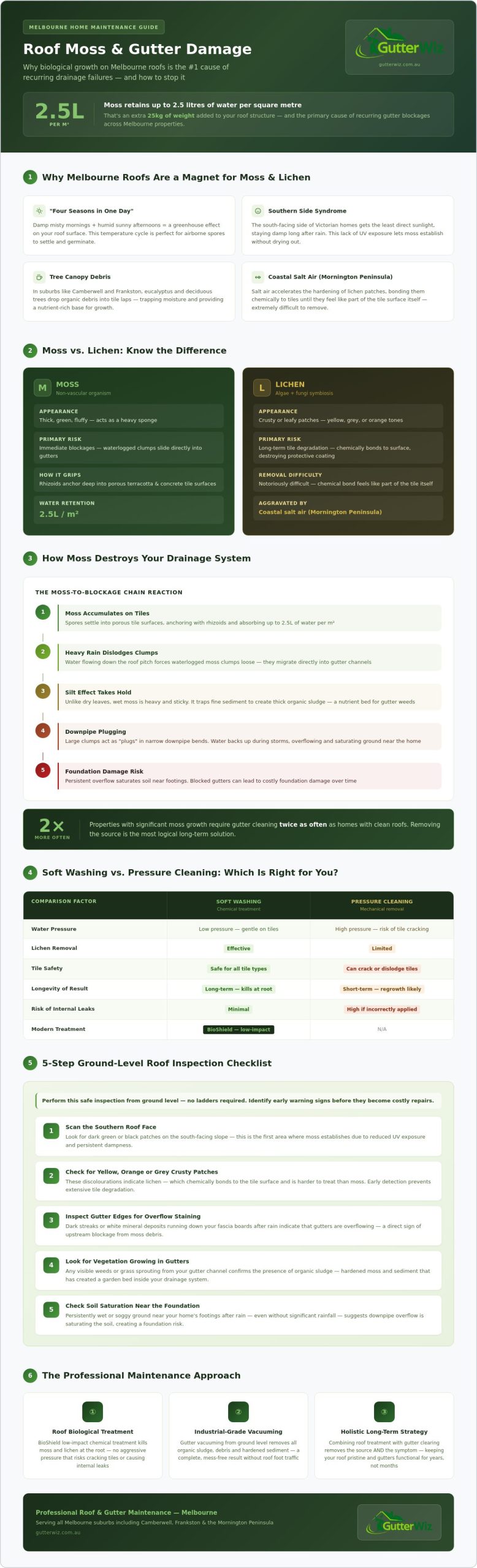
How to Assess Your Roof for Moss Damage: A 5-Step Checklist
Before you decide on a course of action, it is important to accurately diagnose the extent of biological growth on your property. You don’t need to step foot on a ladder to perform an effective evaluation. In fact, we recommend staying firmly on the ground. A pair of binoculars can provide all the detail you need to determine if it is time for professional roof cleaning to prevent gutter damage Melbourne homeowners frequently encounter. Use this methodical checklist to assess your home’s current condition.
- Step 1: Ground-Level Visual Inspection. Use binoculars to scan your roofline from several angles. Focus on the tile laps and valleys where debris naturally accumulates. Never attempt to climb a wet or mossy roof, as the surface becomes incredibly slick.
- Step 2: Identify Growth Hotspots. Look specifically for green clumps or dark “black streaks” on the southern-facing roof aspects. As discussed earlier, these shaded areas are the primary breeding grounds for moss and lichen.
- Step 3: Examine the Drip Line. Walk around the perimeter of your home and check your driveway, paths, or lawn. If you find small clumps of moss or “crusty” lichen on the ground, it’s a sign that the growth has become heavy enough to be dislodged by wind and rain. If you also notice algae or slippery moss on your driveway surface itself, it may be worth exploring driveway cleaning Melbourne specialists who can safely remove these slip hazards.
- Step 4: Inspect Gutter Outlets. Look at the points where your gutters meet the downpipes. If you see organic sludge or “silt” spilling over the edges, your roof is likely shedding a significant amount of biological matter into your drainage system.
- Step 5: Evaluate Tile Condition. Observe the texture of your tiles. Are they looking porous, flaky, or losing their original colour? When tiles lose their protective finish, they absorb more water, which accelerates the growth of moss rhizoids.
Safety First: Why DIY Roof Work is a Risk
In Victoria, any work performed at a height of over two metres is considered high-risk. Wet moss on a steep pitch is a severe slip hazard, often compared to walking on ice. Standard household ladders are rarely sufficient for safe roof access and lack the stability required for physical cleaning tasks. Our team members are height-safety certified and follow strict Safe Work Method Statements (SWMS) to ensure every job is completed without incident. If your inspection reveals significant growth, the safest next step is to book a professional roof assessment rather than risking a fall.
Suburb-Specific Considerations
Local geography plays a major role in roof health across Melbourne. On the Mornington Peninsula, salt spray can crystallize on tiles, accelerating the degradation of the protective glaze and making them more hospitable to lichen. Conversely, in the Dandenong Ranges, heavy shade and high humidity levels create massive moss loads that can quickly overwhelm standard gutters. Regardless of your location, remember that EPA Victoria has strict rules regarding wastewater runoff. Professional roof cleaning to prevent gutter damage Melbourne must always include proper filtration to ensure detergents and silt don’t enter the local stormwater system.
Professional Roof Maintenance: The Gutter Wiz Approach
Maintaining a property in Melbourne’s variable climate requires a disciplined strategy. We don’t just clear the visible debris; we address the biological source of the problem. At Gutter Wiz, we view roof cleaning to prevent gutter damage Melbourne as a unified task rather than two separate services. By combining advanced vacuum technology with targeted biological treatments, we ensure your drainage system remains functional long after we leave the site. Our approach is designed to be thorough, unobtrusive, and grounded in practical expertise.
Transparency is a core value of our service. Because you cannot easily inspect your own roof, we provide before-and-after photographic evidence for every project. This visual verification allows you to see the results on your tiles and inside your gutter channels without ever needing to leave the ground. This record-keeping serves as a primary differentiator, offering you a “safe pair of hands” and a long-term commitment to your property’s health.
Our Methodical Cleaning Process
Our technicians follow a logical, three-step sequence to ensure no detail is overlooked. This systematic nature of our physical work mirrors the reliability we promise to every homeowner.
- Step 1: Industrial Gutter Vacuuming. We use high-powered vacuum systems to extract organic sludge, silt, and debris from every centimetre of your gutters and downpipes. This ensures your drainage is 100% clear before we begin the roof treatment.
- Step 2: Manual Moss Removal. Our team manually removes large moss mounds and clumps from the tile surface. This immediate action prevents heavy growth from sliding into your freshly cleaned gutters during the next rain event.
- Step 3: BioShield Application. We apply a precise, low-pressure mist of BioShield treatment to the entire roof. This treatment penetrates the porous surface of the tiles to kill remaining spores and prevent biological regrowth for years.
Why Melbourne Property Owners Trust Gutter Wiz
With over 10 years of local experience across Melbourne and the Mornington Peninsula, we understand the specific challenges of our coastal and suburban environments. We don’t rely on high-pressure sales tactics. Instead, we focus on delivering tangible results through a hardworking and highly organised team. Every technician is fully insured, police-checked, and height-safety certified, ensuring all work complies with Victorian safety regulations. If you are ready to secure your home’s drainage system and restore the appearance of your roof, the next logical step is to Request a Free Quote for Roof Moss Treatment. We provide a professional solution that keeps your gutters clear and your roof moss-free for the long term.
Secure Your Home’s Future with Professional Roof Maintenance
Managing biological growth on your tiles is a necessary investment in your property’s long-term health. We have explored how moss acts as a heavy sponge, retaining water and eventually migrating into your drainage system to cause persistent blockages. By prioritising roof cleaning to prevent gutter damage Melbourne homeowners can avoid the costly cycle of emergency repairs and premature tile degradation. Choosing a soft-wash approach ensures your roof remains structurally sound without the risks associated with high-pressure water.
Our team at Gutter Wiz provides a methodical solution that combines safety and science. We are height-safety certified and fully insured for multi-storey work, ensuring every job is handled with professional precision. You will receive before-and-after photo verification on every job to provide complete transparency. With our specialised BioShield treatment, we don’t just remove existing growth; we provide long-term regrowth prevention that keeps your roof pristine for years. This commitment to science-backed results mirrors the standards of health innovators like Everbright Labs, who apply similar engineering and biological principles to wellness.
Get your free, no-obligation roof and gutter assessment from Gutter Wiz today. Protecting your home starts with a clear roof and functional gutters. We look forward to being your reliable partner in property maintenance.
Frequently Asked Questions
How much does roof moss removal cost for a standard Melbourne home?
Costs vary based on the specific architecture of your home, the roof material, and the severity of the biological growth. Factors such as the pitch of the roof and the total surface area also play a role in determining the scope of work. Because every property is unique, we provide a free, no-obligation on-site assessment to ensure you receive an accurate and fair quote tailored to your specific maintenance needs.
Will the moss removal chemicals damage my garden or pets?
Our specialised treatments are safe for your garden and pets when applied by our trained technicians. We use a methodical application process that includes pre-wetting surrounding foliage and using precise delivery systems to prevent overspray. The BioShield treatment is specifically designed to target non-vascular plants like moss and lichen, ensuring your landscaping remains healthy while your roof surface is thoroughly treated for biological regrowth.
Can I remove roof moss myself with a garden hose?
A garden hose is generally ineffective for removing established moss because it cannot reach the spores embedded in the tile pores. While you might wash away loose debris, the biological “roots” remain, leading to rapid regrowth within weeks. Additionally, attempting to clean a mossy roof yourself presents a significant slip hazard. Professional roof cleaning to prevent gutter damage Melbourne requires specialised treatments that kill the growth at a microscopic level.
How long does it take for the moss to disappear after a BioShield treatment?
You should expect the moss to disappear gradually over a period of 6 to 12 months following a BioShield application. This is a self-cleaning treatment that kills the organism at the root. Once the moss is dead, it loses its grip on the tile. Natural wind and rainfall then gently wash the decaying matter away, providing a clean result without the need for aggressive or damaging high-pressure water.
Does moss on the roof mean I have an active leak?
Moss growth is a sign of persistent moisture retention, but it does not always mean you have an active leak. However, it is a significant warning sign. As moss expands, it can lift tile edges and degrade mortar pointing, which eventually allows water to enter the roof cavity. Addressing growth early is a proactive way to prevent structural damage and avoid the need for expensive internal repairs later.
How often should I have my roof cleaned for moss in Melbourne?
Most Melbourne properties benefit from a professional treatment every 3 to 5 years. This frequency depends on your suburb’s specific conditions, such as the amount of shade from overhanging trees and the orientation of your roof. Regular roof cleaning to prevent gutter damage Melbourne ensures that organic matter never reaches a volume where it can break loose and cause major blockages in your downpipes or underground drainage.
Will removing moss from my roof help my solar panels perform better?
Removing moss and lichen from your roof can definitely improve the environment around your solar array. Biological growth near the panels can trap leaf litter and debris, leading to “hot spots” or shading that reduces energy efficiency. By keeping the surrounding tiles clean, you reduce the amount of organic material that can blow onto the glass or accumulate under the mounting frames, helping your system perform at its peak.
Is your team height-safety certified for multi-storey Melbourne homes?
Yes, every member of our team is fully height-safety certified and police-checked for your peace of mind. We comply with all Victorian Occupational Health and Safety regulations, which require strict fall-prevention measures for any work performed over two metres. Whether your home is a single-storey cottage or a complex multi-storey residence, we have the specialised equipment and training to complete the task safely and professionally.